CONSTELLATION PRODUCT / PLATFORM

One security platform for your clusters.

Constellation runs inside the Kubernetes clusters it protects. It finds what is running, scans it, checks it at admission, watches it at runtime, maps its traffic and keeps the evidence, in one console with one audit trail.

Early alpha · Not production-ready · Defaults noted per area

01 / PRODUCT AREAS

See, know, control, prove.#

Select an area to see the screen and the specifics. Each one has its own page with the limits spelled out.

SEE WHAT IS RUNNING / ON BY DEFAULT

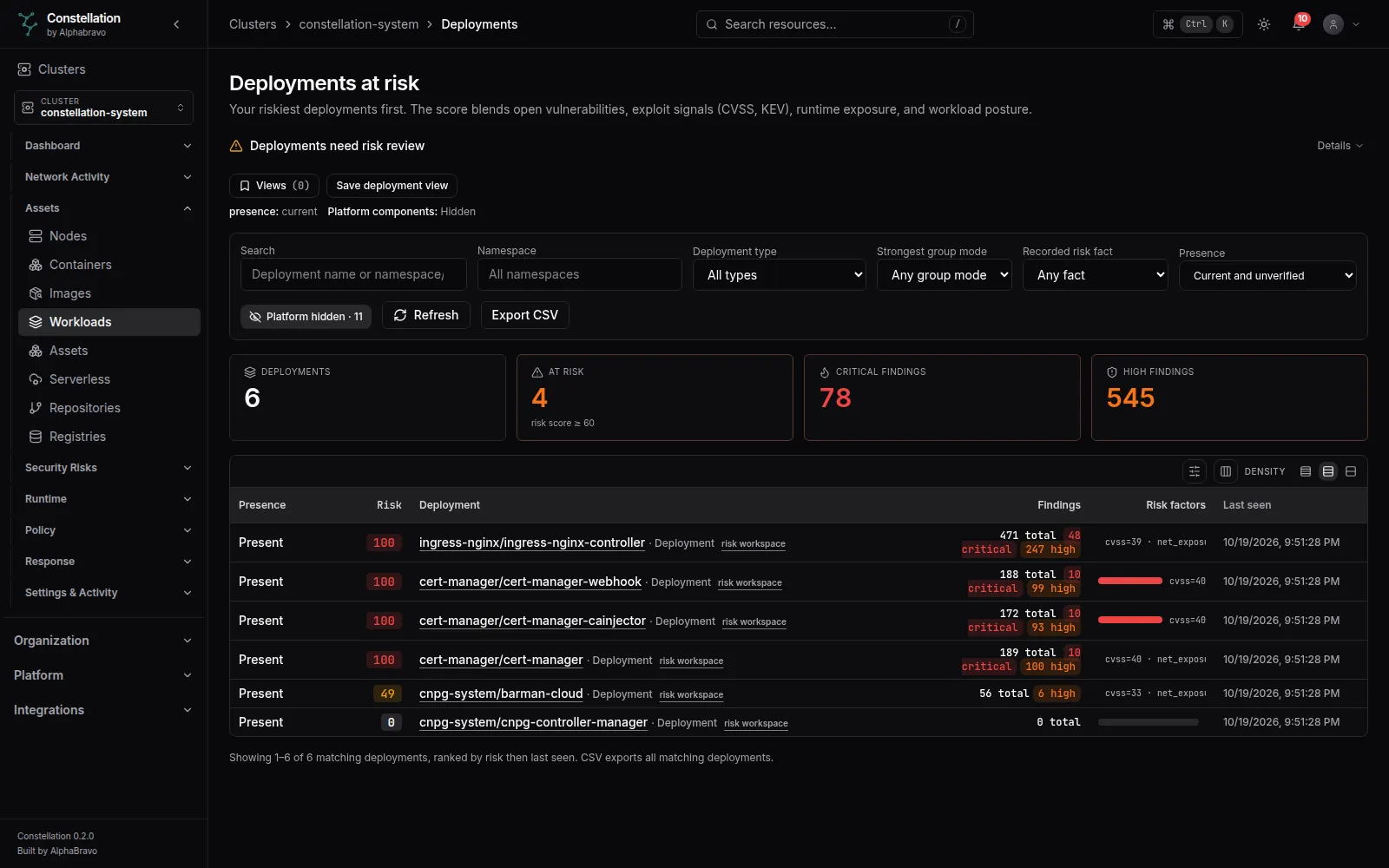
Inventory

The discoverer watches each cluster and records namespaces, workloads, images, nodes and platform facts. Workloads link to the images they run, so every finding has a place in the estate.

  • Deployments flagged when privileged, running as root or on the host network.
  • Node detail with host packages and facts from the runtime agent.
  • A clusters view to start triage from.
Constellation screen for InventoryConstellation screen for Inventory

02 / SAFE DEFAULTS

Observe first. Enforce when you choose.#

A default install sees and reports a lot and blocks very little. That is deliberate: you decide where enforcement starts.

ON BY DEFAULT

Visibility and the basics

  • Inventory, scanning and KEV/EPSS prioritization
  • Admission webhook with three blocking rules (fails open)
  • Runtime agent in monitor mode: detect and alert
  • Traffic map and policy candidates
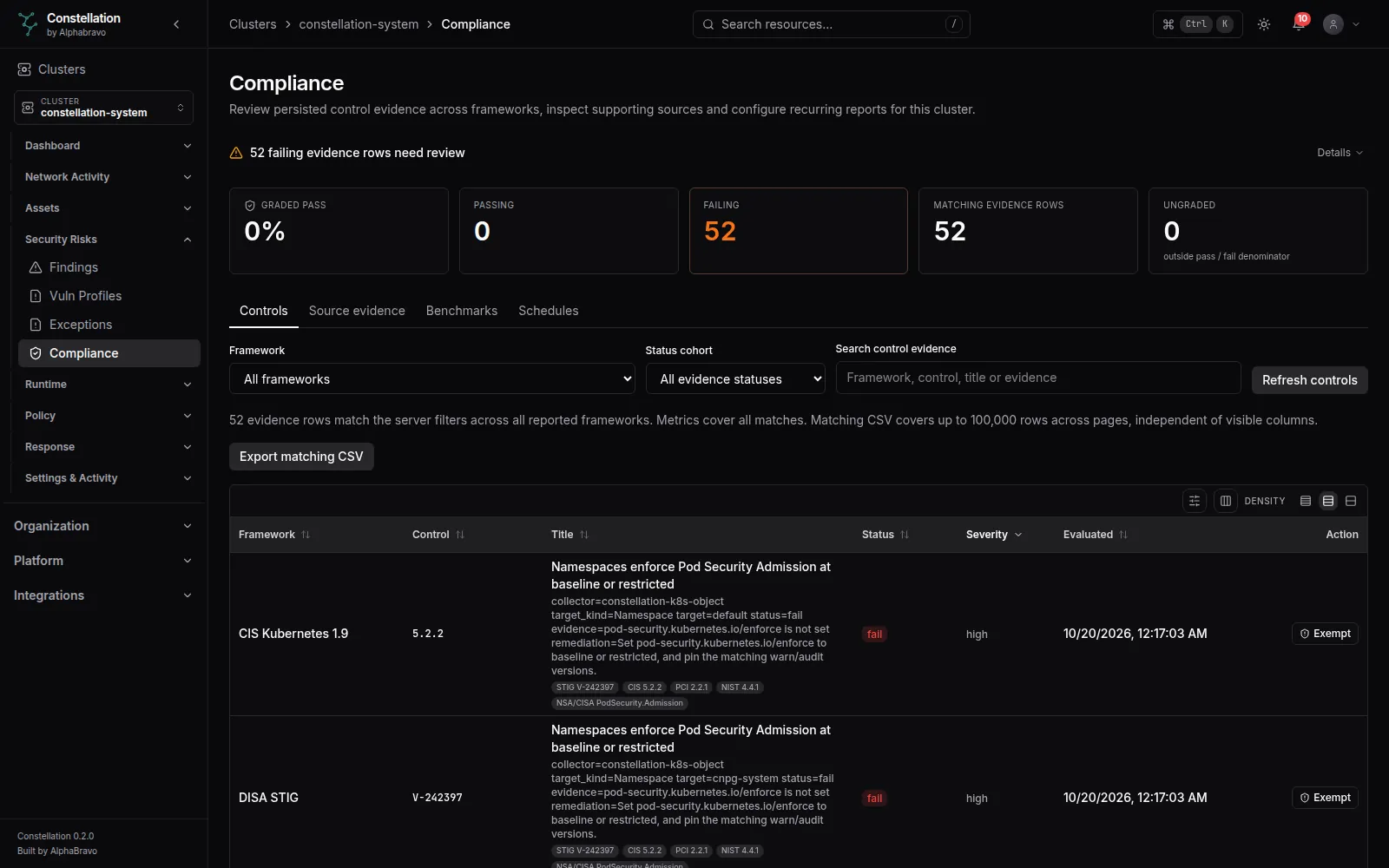
  • Compliance collector and hash-chained audit log
OPT-IN

Enforcement and extras

  • Runtime protect mode, per workload
  • Inline network, WAF and DLP blocking, per labeled pod
  • Database-backed admission policies, quarantine list and admission audit
  • kube-bench and docker-bench runners; audit archiver
  • Offline scanning, NVD import, high availability, chart NetworkPolicies

03 / COVERAGE HEALTH

Know the sensors are working.#

Security coverage only counts if the agents, scanners and webhooks behind it are healthy. System health shows build versions, restarts, version drift and stale or crashlooping components for the control plane and every connected cluster, and produces a redacted support bundle.

04 / GO DEEPER

Pick the part you need to trust.#

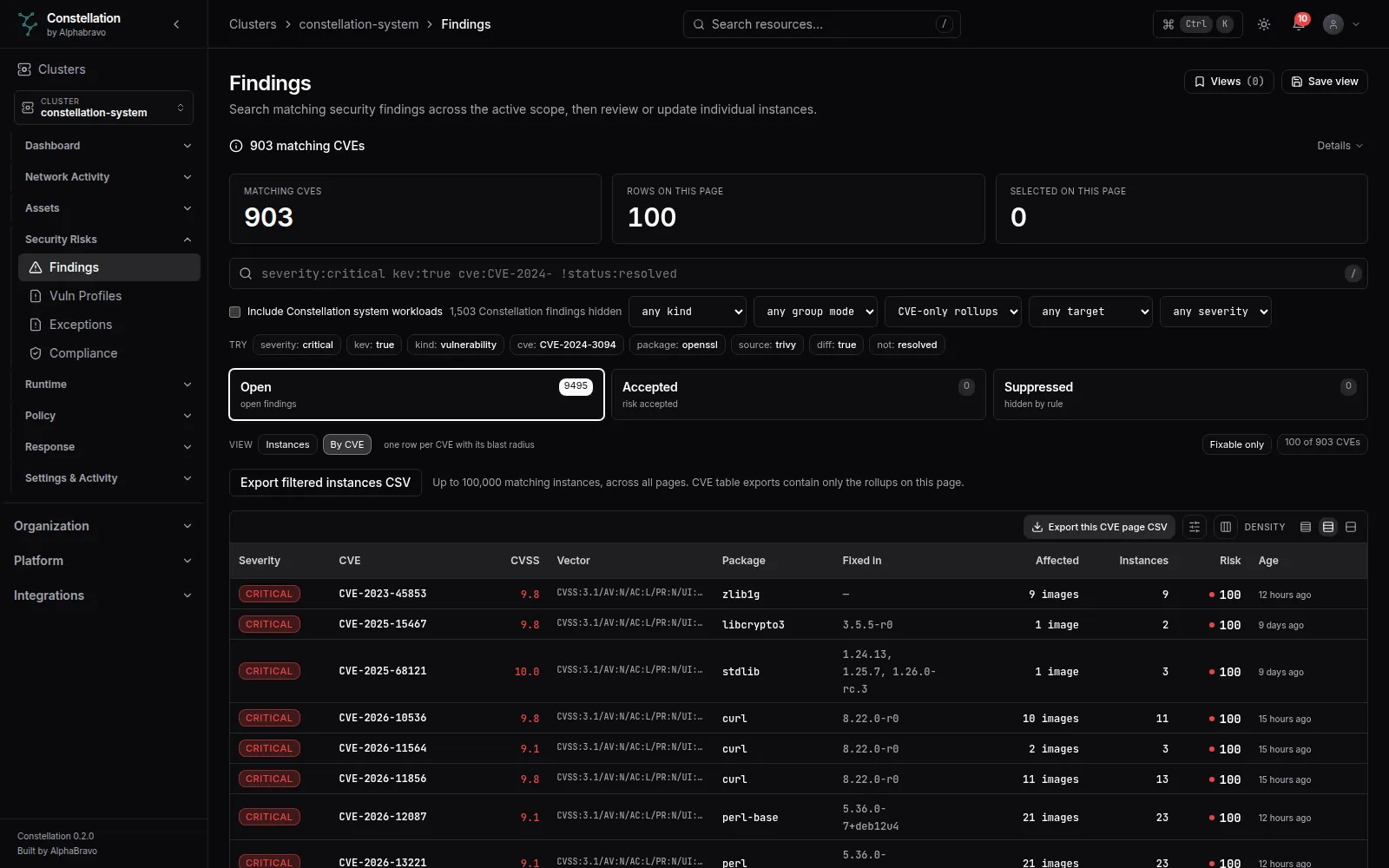
VULNERABILITIES

Scanning and prioritization

Targets, engines, risk score, exceptions, CI and offline scanning.

Vulnerabilities
ADMISSION

Guardrails and signatures

Default rules, profiles, simulation, scan-backed gates and cosign verification.

Admission & supply chain
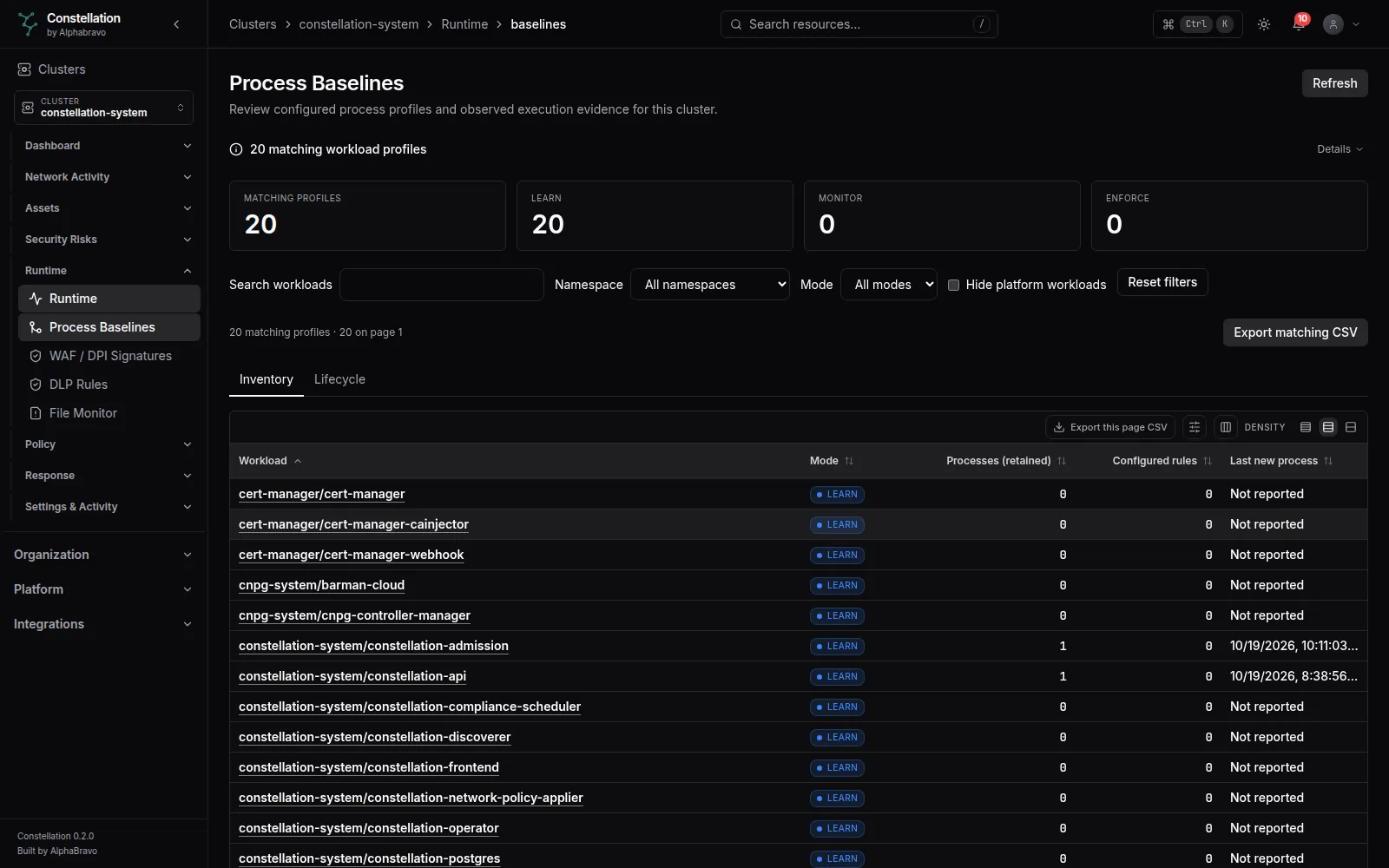
RUNTIME

Baselines and response

The agent, Learn/Monitor/Enforce, WAF and DLP, response rules and quarantine.

Runtime
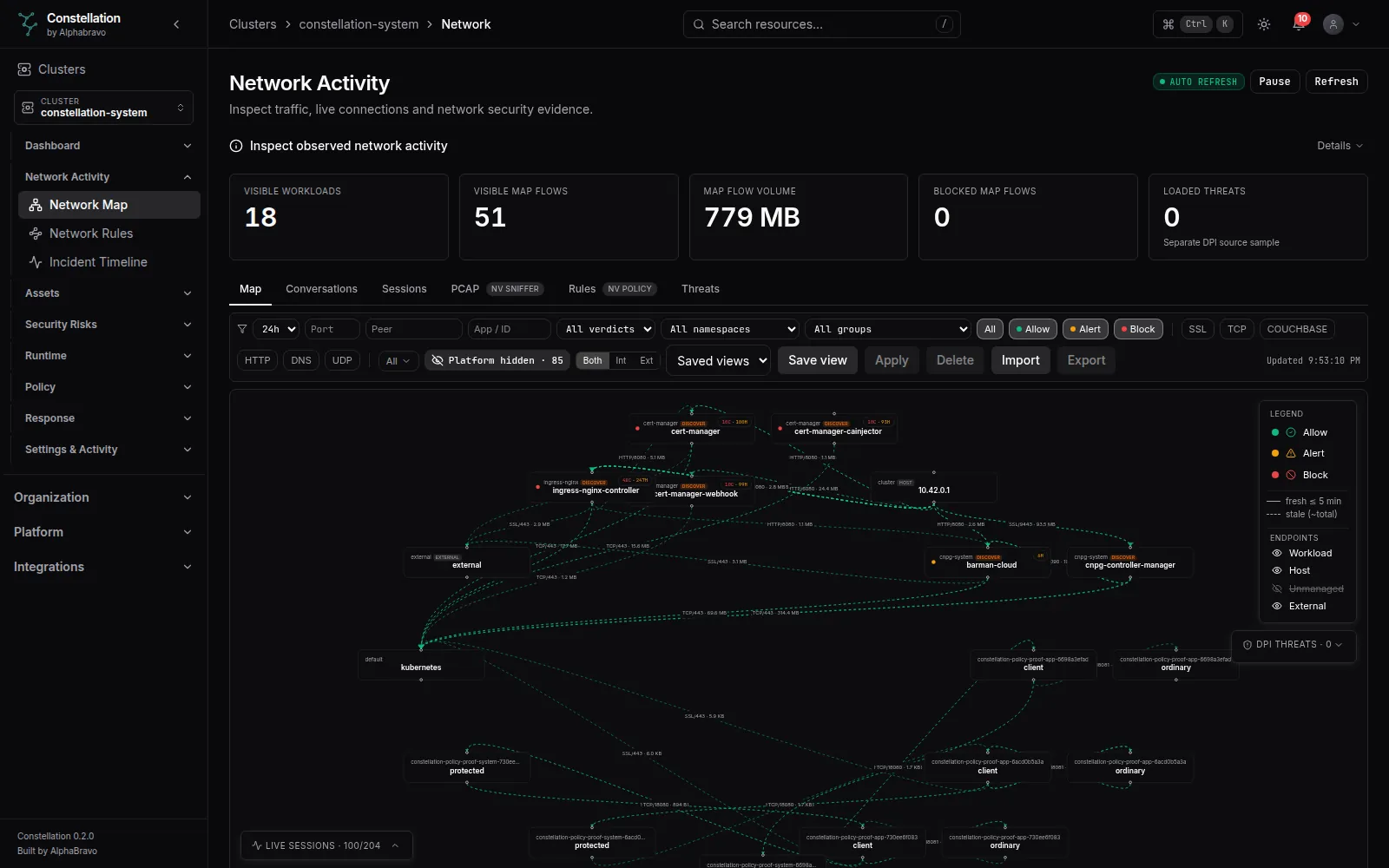
NETWORK

Traffic and policy

The traffic map, the approve-apply-rollback lifecycle and CNI support.

Network
ARCHITECTURE

How it is built

Components, PostgreSQL, Helm and multi-cluster registration.

Architecture

FAQ

Platform questions.#

Is Constellation a SaaS?

No. You install it in your own Kubernetes cluster with its Helm chart. Its data stays in your PostgreSQL database. #

Does it replace our scanner?

It runs open-source scanners for you, Syft, Trivy and Grype, and adds what sits around them: workload correlation, KEV and EPSS prioritization, exceptions with an audit trail, admission gates and a runtime view. #

Can we use it in production?

Not yet. Constellation is in early alpha: interfaces and data formats can change without notice, and there are no stability, security or support guarantees. Use it in a lab and tell us what you find. #

NEXT STEP

See Constellation with your environment in mind.

Tell AlphaBravo what you run today. We will show you the workflows that matter to your team.

Find your next step

12 pages

Tab through results · Enter to open · Escape to close